
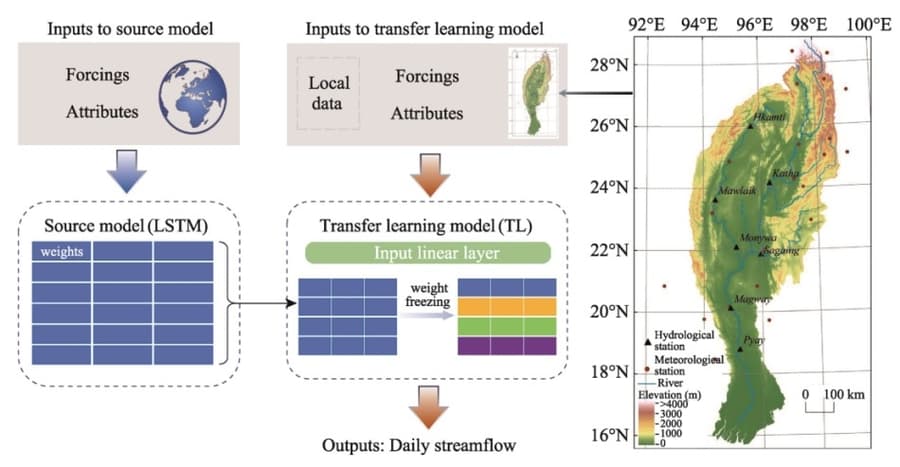
In a significant advancement for hydrological science and water resource management, researchers from Yunnan University and Pennsylvania State University have developed a novel transfer learning framework that dramatically enhances the accuracy of daily streamflow forecasts in data-scarce regions. This innovative approach, detailed in a recent publication in the Journal of Geographical Sciences, addresses long-standing challenges in streamflow modeling and offers new possibilities for water security in vulnerable areas.
The study, published on May 10, 2024, focuses on the application of transfer learning techniques to overcome the limitations posed by sparse gauge distribution and data scarcity in large transboundary basins. These areas, critical for water supply and climate change impact assessment, have historically been difficult to model due to complex hydrological processes and insufficient data.
The researchers tested their transfer learning framework in the Dulong-Irrawaddy River Basin, a transboundary region that has been traditionally underserved by conventional modeling approaches. The results are promising, with the new model outperforming traditional process-based models and demonstrating remarkable adaptability to the basin's unique hydrological characteristics.
One of the key strengths of the transfer learning approach is its ability to capture intricate, nonlinear interactions among variables. Through sensitivity analysis, the researchers found that the model excels at delineating diverse flow patterns and spatial variations within large-scale catchments. This capability not only improves prediction accuracy but also deepens our understanding of complex hydrological systems.
Dr. Ma Kai, a principal investigator and co-author of the study, emphasized the significance of this research, stating, "This research not only meets the urgent demand for reliable streamflow predictions in regions with limited data but also paves the way for a more profound comprehension of the complex dynamics governing our hydrological systems."
The implications of this study extend far beyond academic circles. As climate change continues to alter precipitation patterns and water availability worldwide, accurate streamflow forecasting becomes increasingly crucial for effective water resource management. The transfer learning framework provides a powerful tool for decision-makers and water managers, especially in regions where data scarcity has historically hindered accurate predictions.
For transboundary basins, which often face unique challenges due to their cross-border nature, this new approach could facilitate more informed and collaborative water management strategies. By providing more reliable streamflow forecasts, the model can help prevent conflicts over water resources and support more equitable water allocation among different users and ecosystems.
The study's success in the Dulong-Irrawaddy River Basin also opens up possibilities for application in other data-scarce regions around the world. As the model demonstrates its ability to adapt to specific hydrological conditions, it could be particularly valuable in developing countries or remote areas where establishing comprehensive gauge networks is challenging or cost-prohibitive.
Moreover, the enhanced understanding of hydrological processes that this model provides could contribute to more effective climate change mitigation and adaptation strategies. By improving our ability to predict and understand streamflow patterns, policymakers and environmental managers can make more informed decisions about water infrastructure, flood control measures, and ecosystem conservation efforts.
As water scarcity becomes an increasingly pressing global issue, the development of this transfer learning framework represents a significant step forward in our ability to manage and protect this vital resource. By bridging the gap between data-rich and data-poor regions, this innovative approach has the potential to democratize access to accurate hydrological forecasting and support more sustainable water management practices worldwide.
